7 October 2026 · PIP Helper Team
PIP tribunal appeal: what to expect on the day
Around 65–70% of PIP claimants who attend tribunal succeed. This guide covers what a tribunal actually is, who’s in the room, what they’ll ask, and how to prepare.
Key Takeaways
- PIP tribunal success rate: 65–70% when the claimant attends, 25–30% on paper-only appeals.
- The panel is three members: judge, doctor, disability specialist. Independent of the DWP.
- A typical hearing is 30–45 minutes, with the panel deliberating ~10–20 minutes afterwards.
- You can bring a representative and a supporter. Free representation is available through Citizens Advice and other welfare-rights services.
- Choose in-person, video, or phone over paper. Attendance roughly doubles your chance of success.
If your Mandatory Reconsideration didn’t change the decision, the next step is to appeal to a First-tier Tribunal — an independent body that reviews benefit decisions, separate from the DWP.
If you’re imagining a courtroom, it’s worth resetting the picture now. Tribunals are deliberately informal. There’s no jury, no opposing barrister cross-examining you, no judge in robes. The format is closer to a panel discussion than a court proceeding. Most last around 30–45 minutes. Most claimants who attend in person succeed.
This guide is a slow read of what to expect on the day, who’s in the room, what they’ll ask, and how to handle it.
What is the 65–70% success rate?
The headline statistic is real and worth understanding. According to HMCTS tribunal statistics, around two-thirds of PIP appeals succeed when the claimant attends in person, with most receiving a higher award than they originally claimed.
Why so high? A few reasons:
- The tribunal is independent. The judge and panel are not DWP employees. They have no quota and no incentive to uphold decisions.
- A doctor sits on the panel. They understand conditions and impairments in a way many DWP assessors do not.
- The descriptors are applied carefully. Tribunals tend to be much better at applying the 50% rule and the reliability test than first-decision assessors.
- New evidence is allowed. Anything you couldn’t get for first decision or MR can be supplied at tribunal.
- The claimant is in the room. The mismatch between an assessor’s “appears well” report and the claimant’s actual presentation is often visible at tribunal.
Importantly, the success rate is much higher when the claimant attends. Attendance — in person, by video, or by phone — is one of the most consequential decisions in the appeal process.
How do you lodge the appeal?
After your MR decision letter, you have 1 month to lodge a tribunal appeal. The process:
- Form SSCS1 (the appeal form) — download from gov.uk or request from the tribunal service
- Complete the form with your details, the decision you’re appealing, and a brief summary of why
- Send the form to HM Courts and Tribunals Service (HMCTS), with a copy of your MR decision letter
The form has space for your reasons for appeal. Keep this short — a paragraph naming the activities you believe were wrongly scored is enough at this stage. The detailed argument can be supplied later, in writing or at the hearing itself.
Once submitted, you’ll receive an acknowledgement, then a response from the DWP (called a “response bundle”), then an appointment for the hearing.
Wait time from appeal lodged to hearing in 2026 is typically 6–12 months, depending on region.
The response bundle
A few weeks after lodging your appeal, you’ll receive a thick package from HMCTS. This is the “response bundle” — every document the tribunal will have at your hearing.
It typically includes:
- Your original PIP form
- Your assessment report
- The original decision letter and reasoning
- Your MR letter and the MR decision
- The DWP’s response to your appeal (with their reasoning for upholding the decision)
Read this carefully. Some specifics:
- The DWP’s response is sometimes the first time you’ll see why they’ve upheld the decision in detail. The reasoning will be more developed than in the original decision letter.
- Note any errors of fact in the response. These are useful at the hearing.
- Identify the specific descriptors in dispute. The tribunal will focus on these.
You can also send additional evidence to the tribunal at any point before the hearing. Send it directly to HMCTS (not the DWP), with the appeal reference number.
Format options: in person, video, phone, paper
When your appointment is scheduled, you’ll be asked which format you prefer.
| Format | Description |
|---|---|
| In-person | At a tribunal venue (often a converted courthouse or public building). Travel expenses can be reimbursed. |
| Video | From home, by video conference. Set up via the HMCTS video service. |
| Phone | From home, by audio call. |
| Paper | The tribunal decides without you attending. Lower success rate; not recommended unless you have specific reasons. |
Choosing the format:
- In-person is generally most effective. Being in the room is the strongest version of attending. Body language, the panel’s ability to observe you, your ability to read the room — all of this works best face-to-face.
- Video is a good second option, particularly for claimants who can’t reasonably travel. The success rate is similar to in-person.
- Phone is acceptable for claimants with severe travel difficulties, agoraphobia, or other specific reasons. It’s slightly less effective than video, but still much better than paper.
- Paper has the lowest success rate. Choose it only if attending in any format would be impossible.
If in doubt, choose in-person. The expenses are reimbursable and the panel takes the time to listen.
Who’s in the room?
A First-tier Tribunal panel for a PIP appeal has three members:
- A judge — legally qualified, chairs the hearing
- A medically qualified panel member — typically a doctor (registered medical practitioner)
- A disability qualified panel member — has experience of disability, often through professional or personal background
This is unusual for a tribunal. Many tribunals have a single judge; PIP appeals (and other disability benefit appeals) specifically have a three-member panel including a doctor. The point is that someone on the panel understands disability from a clinical and lived perspective.
In addition to the panel:
- A clerk — administrative role, sets up the hearing, manages paperwork
- A DWP presenting officer (occasionally — many tribunals proceed without one) — represents the DWP’s position
- You — the appellant
- A representative if you have one — Citizens Advice, a welfare-rights worker, or anyone else you’ve asked to support you
- A supporter — a partner, friend, or family member, in addition to or instead of a formal representative
The tone is informal. The panel will introduce themselves. They’ll explain the process. They’ll ask you questions, and they’ll ask their own questions of each other and of any DWP presenting officer.
How long does the hearing take?
A typical PIP tribunal hearing is 30–45 minutes. Some are shorter, some longer.
The structure is roughly:
- Introductions — 5 minutes
- The judge explains the process — 2–3 minutes
- Questions to the appellant — 20–30 minutes
- Any DWP presenting officer comments — 0–5 minutes
- You or your representative make a closing statement — 2–5 minutes
- The panel deliberates in private — typically 10–20 minutes (you wait outside)
- The decision is announced — 1–5 minutes
Most tribunals hear several appeals in a day. Yours is one of a list; expect to wait at the venue for some time before your hearing, and possibly for some time afterwards while the panel decides.
What will they ask?
The questions a tribunal asks are different from an assessment. They’re focused on the activities in dispute and on understanding your daily function. The panel has read your form, your assessment report, and your MR. They’ve seen the decision and the DWP’s response. They’re not starting from scratch.
The kinds of questions:
- “Can you describe a typical day for us?” — same trap as in an assessment, same answer (refuse the premise; describe most days, with frequency)
- “How did you get here today?” — understand who brought you, how you managed the journey
- “You said in your form that you cannot cook a meal. Can you tell us more about that?” — clarification on specific descriptors
- “What helps you most? Who helps you?” — understanding the support network
- “What’s changed recently? Has your condition got better, worse, the same?” — current status
The panel will probe gently. They won’t try to catch you out. If they hear something inconsistent, they’ll ask about it directly so you have a chance to clarify.
For sensitive topics — toileting, washing, mental health — the panel will be tactful. The doctor on the panel is used to this kind of conversation. You don’t need to be more graphic than necessary; you do need to be honest. “I have difficulty managing toilet needs” with a brief specific description is enough; you don’t need to describe each incident.
Bringing a representative or supporter
You can bring:
- A representative — someone who speaks on your behalf, typically a welfare-rights worker, Citizens Advice volunteer, lawyer, or other formal support
- A supporter — a partner, family member, or friend who attends with you, may speak briefly if relevant, but doesn’t represent you
A representative is particularly useful if:
- You find it hard to articulate your situation under questioning
- The case has complex descriptor or rule arguments
- You have a condition (autism, severe anxiety, learning disability) that makes the format difficult
Free representation is available through:
- Citizens Advice in many areas
- Disability Rights UK
- Z2K for some regions
- Local welfare rights services at councils, law centres, and housing associations
- Benefits and Work — paid representation for some cases
A supporter is useful for almost any claimant. Even if they don’t speak, having someone in the room helps. They can corroborate something you’ve said, prompt you if you’ve forgotten to mention something, and provide moral support.
What to wear, where to sit, how to speak
The format is informal. Dress how you feel comfortable. Many claimants come in everyday clothes; some dress smarter; both are fine. There’s no expectation of formality.
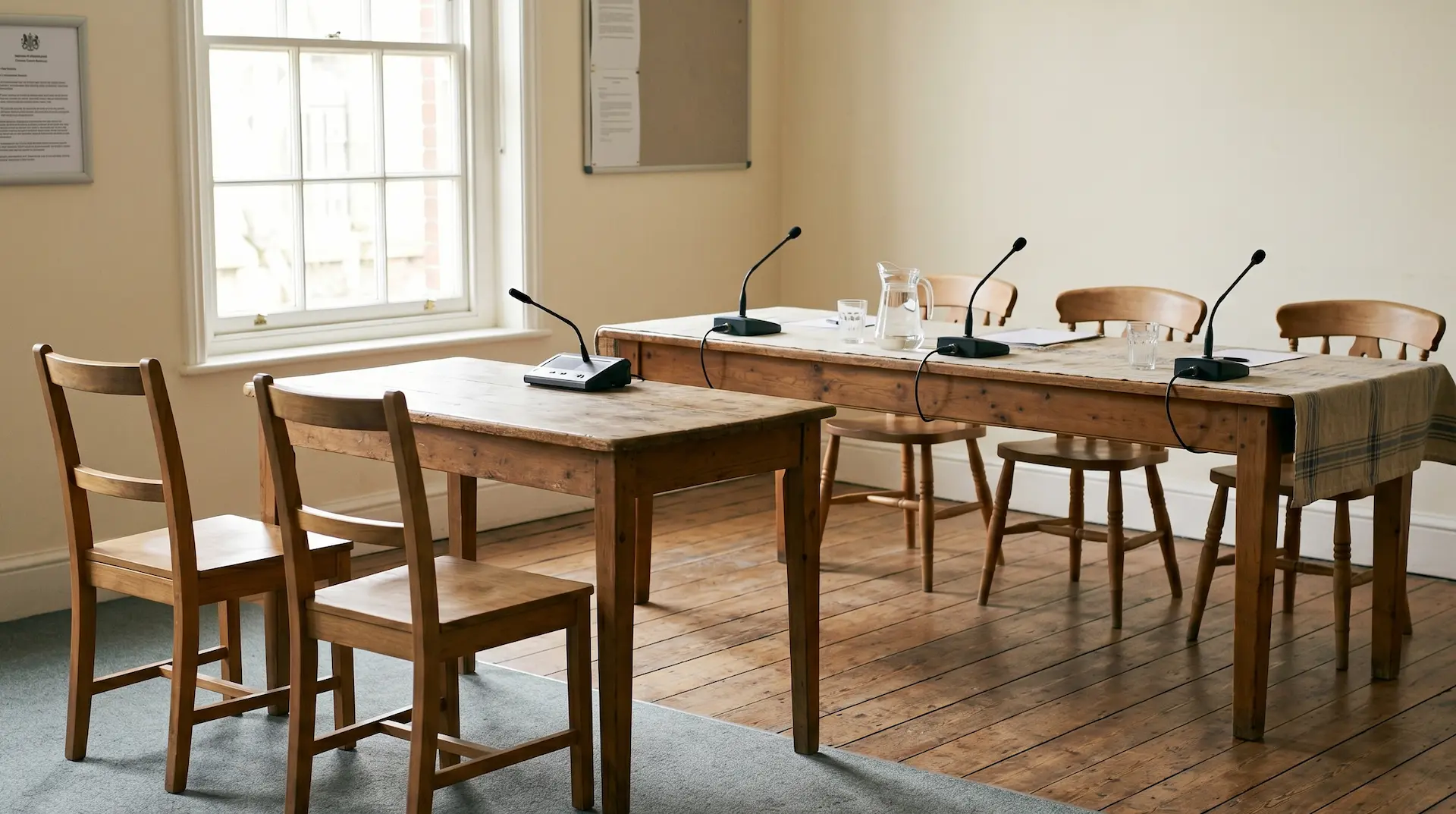
You’ll typically sit on one side of a table or arrangement, with the panel on the other. Your representative or supporter sits next to you. The DWP presenting officer (if present) sits at a different position, often opposite or to the side.
Speak normally. Address the judge as “judge” or “sir/madam” if you want; “you” is also fine. The medical and disability members can be addressed by name (they’ll introduce themselves) or just included in the conversation.
If you don’t understand a question, ask. “Sorry, could you say that another way?” is fine. The panel wants you to be able to answer; they’ll rephrase as needed.
If you need a break, ask. The judge can pause the hearing. This is particularly relevant for mental health and chronic illness claimants — overwhelming distress, panic, fatigue, pain — all are valid reasons to ask for a few minutes.
What if you can’t go?
If you can’t attend on the scheduled date — illness, hospital admission, family emergency, transport breakdown — phone HMCTS as soon as possible. The hearing can usually be rescheduled.
If you don’t attend without notifying anyone, the tribunal may:
- Adjourn and reschedule (if it’s clear you intended to attend)
- Decide on the papers (if it appears you’ve withdrawn from attendance)
Either way, the tribunal won’t simply dismiss your case for non-attendance, but you’ll have lost the opportunity to attend and given up the higher success rate.
The decision
After the hearing, the panel deliberates in private. You wait outside (or in a different room). When they’re ready, you’re called back in and the decision is announced.
Possible outcomes:
- Appeal allowed — the decision is changed. The panel will state the new award (typically standard or enhanced rate, daily living/mobility/both, and the start date).
- Appeal partially allowed — the decision is changed but not as much as you wanted. For example, you appealed for enhanced and were awarded standard.
- Appeal dismissed — the original decision stands.
If the appeal is allowed, you’ll receive:
- A short oral statement of the decision on the day
- A written decision in the post within a few days
- The new award starting from the date of the original decision (backdated)
The DWP will pay any backdated amount as a lump sum within a few weeks. They’ll also adjust your ongoing payments to the new rate.
If the appeal is dismissed, you have limited further options. You can request a “statement of reasons” (a fuller written explanation) and, in narrow circumstances, appeal to the Upper Tribunal — but only on points of law, not the facts of the case. This is rare and usually requires legal advice.
How to prepare in the days before
A short list:
- Re-read your form and the response bundle. Be familiar with what’s in front of the panel.
- Prepare any new evidence. Send anything new directly to HMCTS, with the appeal reference number, ideally at least 14 days before the hearing.
- Plan the journey. Know how you’ll get there, who’s with you, where to park. Travel expenses can be reimbursed — keep receipts.
- Identify the descriptors in dispute. Know which activities and which descriptors you’re arguing for. The panel will ask.
- Practise answering “describe a typical day.” Have a structured answer ready.
- Plan a closing statement. A short paragraph at the end of the hearing — “I would like the panel to consider…” — covering the key points.
- Get rest. A tribunal day is exhausting. Plan a quiet day before and after.
A note on the wait
Tribunal waiting times in 2026 are typically 6–12 months from appeal lodged to hearing. This is hard. The wait happens during a period when you’re often without PIP income, dealing with the original condition, and uncertain whether the appeal will succeed.
A few practical things:
- Stay organised. Keep your form, MR, response bundle, and any new evidence in one place.
- Update your evidence. Keep a symptom diary going through the wait. Get fresh clinical letters if your condition has changed. Anything you can supply 14 days before the hearing can be considered.
- Notify HMCTS of changes. If your address changes, your contact details change, or your condition changes significantly, write to HMCTS with the appeal reference.
- Stay in contact with a welfare-rights advisor if possible. They can chase progress and help with new evidence.
Free help and where to next
Tribunal representation is the area where free welfare-rights advice has the most impact.
- Citizens Advice — free representation in many areas, and detailed appeal preparation
- Disability Rights UK — specialist welfare rights advice
- Z2K — specialise in benefits appeals and tribunal representation
- Scope — detailed appeals guidance
- Your local welfare rights service — many councils, law centres, and housing associations offer free representation
Companion guides:
- PIP refused: what happens next — the start of the appeal journey
- How to write a Mandatory Reconsideration request — the prior step
- Got zero points on PIP? Why this often gets overturned — for nil-award appeals specifically
- PIP descriptors explained — the foundational reference
If you’d like a tool that helps you organise for tribunal — surfacing your form, the assessment report, and the descriptor analysis in a clear preparation format — you can start with us. You stay in control of every word that goes on your appeal.
This page describes PIP tribunal processes as they stand in 2026. First-tier Tribunal procedure is set out in the Tribunal Procedure (First-tier Tribunal) (Social Entitlement Chamber) Rules 2008 (retrieved May 2026) and HMCTS guidance. Success-rate statistics are from HMCTS quarterly tribunal statistics. This is general information, not legal advice — please get specialist help if you can.